I’ve watched thousands of kids—and plenty of beer-leaguers—try to fly down the wing like McDavid, only to catch an edge and eat glass because they were skating straight up like a flagpole. Here’s the ugly truth: if your foundation is garbage, the rest of your game crumbles. You can spend thousands on carbon-fiber sticks and custom-baked skates, but if you don’t know how to squat and hold your weight properly, you’re just throwing money into a snowdrift. Trust me on this. Let’s break down the mechanics of the ultimate hockey stance and posture so you can finally stop fighting your own edges.

- • The Anatomy of a Broken Stance (And How to Fix It)
- • Why Your Center of Gravity Is Sabotaging Your Speed
- • Hands and Head: The Final Pieces of the Posture Puzzle
- • Training the Stance Off the Ice
- ↳ Why do my lower back and legs hurt after working on my hockey stance?
- ↳ How wide should my feet be in a standard hockey stance?
- ↳ Can adults relearn their skating posture, or is it too late?
- ↳ Should my weight be on my toes or my heels?
Key Takeaways & Quick Overview
AI Verified
- ✔I’ve watched thousands of kids—and plenty of beer-leaguers—try to fly down the wing like mcdavid, only to catch an edge and eat glass because they were skating straight up like a flagpole.
- ✔Here’s the ugly truth: if your foundation is garbage, the rest of your game crumbles.
- ✔You can spend thousands on carbon-fiber sticks and custom-baked skates, but if you don’t know how to squat and hold your weight properly, you’re just throwing money into a snowdrift.
- ✔Let’s break down the mechanics of the ultimate hockey stance and posture so you can finally stop fighting your own edges.
The Anatomy of a Broken Stance (And How to Fix It)
Most players think they are bending their knees when, in reality, they’re just bending at the waist. I see it every single time I step onto a sheet of ice. They fold forward like cheap lawn chairs, sticking their rear ends out, thinking that counts as an athletic posture. It doesn’t. When your chest collapses downward, your center of gravity shifts forward over your toes, killing your stride length and destroying your lower back.
To fix this, you need to understand where your power actually originates. It starts in the ankles and hips. Your ankles need to push forward into the tongue of your skates. If your ankles are locked and rigid, your knees physically cannot travel forward over your toes. The moment you push those knees forward, your quads engage, your hips drop into a powerful quarter-squat, and your torso naturally straightens out. According to coaching education frameworks by USA Hockey, maintaining this knee-over-toe alignment is non-negotiable for efficient edge control.
- Ankle Flexion: Press the shins hard against the tongues of your boots.
- Knee Bend: Your knees should track directly over the middle of your feet, never caving inward.
- Hip Drop: Sink your hips down, as if you’re trying to sit on a low stool just behind the goalie’s net.
Why Your Center of Gravity Is Sabotaging Your Speed
Speed isn’t just about leg turnover. It’s about physics. If you skate upright, your center of gravity is too high, meaning every push you take sends energy outward instead of downward and backward. You slip. You wobble. You burn out your stamina in two shifts.
When you drop your hips and keep your chest up, you create a loaded spring. Watch any highlight reel from the NHL, and you’ll notice that elite players rarely skate with a straight back. They are perpetually coiled. This posture allows them to absorb body contact without getting launched into the third row, while also granting them the ability to transition instantly from a glide to an explosive crossover.
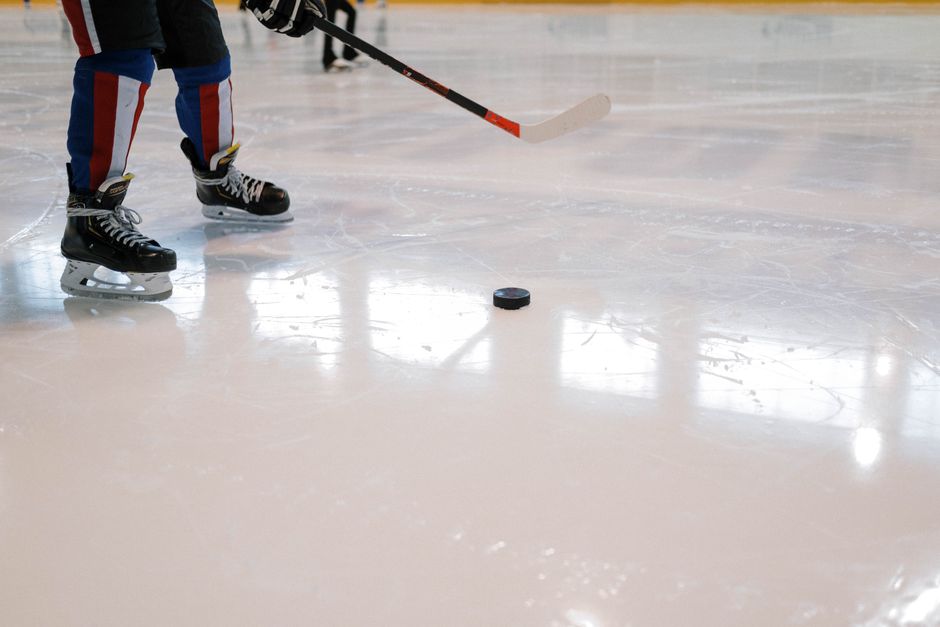
Let’s talk about width. If your skates are glued together, you have zero lateral stability. You’re basically unicycle riding on blades. Your feet need to be at least shoulder-width apart—sometimes wider when you’re entering a board battle or setting up a shot. A wide base combined with a low center of gravity makes you an absolute anchor on the ice. Try moving a player who has mastered this stance. You won’t. They’ll just absorb your check and skate right through your hands.
Hands and Head: The Final Pieces of the Posture Puzzle
You’ve got your lower body locked in. Knees bent, ankles flexed, feet wide. Now what are your upper extremities doing? If your hands are glued to your ribs like a T-rex, you can’t protect the puck. If your head is staring straight down at the logo on your sweater, you’re going to miss a freight-train hit coming out of the neutral zone.
Your hands need to be out in front of your body, creating a pocket of space between your chest and the top hand. This gives you a massive radius to stickhandle, receive hard passes, and absorb contact without losing control. Simultaneously, your chin has to be up. Keep your eyes scanning the horizon. Good posture isn’t just about physical mechanics; it’s about situational awareness. You can’t make a saucer pass to the back door if you’re inspecting the blue paint.
Here is a quick checklist for your upper body posture:
- Chest Out, Shoulders Back: Prevents your upper back from rounding and locking up your breathing.
- Hands Away from the Body: Maximizes your reach and gives your wrists room to snap.
- Head Up: Eyes scanning above the stick blade at all times.
Training the Stance Off the Ice
You don’t need ice to fix your posture. In fact, practicing on dry land is often better because you can isolate the muscle groups without worrying about falling on your tailbone. Grab a set of resistance bands, find an empty patch of floor, and get into your hockey stance in front of a mirror.
Hold that deep knee bend for 45 seconds. Feel your quads burn? Good. That’s the exact muscle endurance you need on a brutal one-minute shift. Add some lateral slides or rollerblade strides while maintaining that exact spine angle. If your chest drops toward the floor when you get tired off the ice, it’s going to drop on the ice. Drill it until it becomes muscle memory.
Frequently Asked Questions
Why do my lower back and legs hurt after working on my hockey stance?
If you’re feeling sharp pain in your lower back, you are likely bending at the waist instead of squatting with your hips and flexing your ankles. If your quads and glutes are burning, that’s normal muscle fatigue. Proper stance requires intense engagement from your lower body; give your muscles time to adapt to the new workload.
How wide should my feet be in a standard hockey stance?
As a general rule, your skates should be roughly shoulder-width apart. However, this varies depending on the situation. During a powerful skating stride, your feet will compress and extend, but during battles, corner work, or shooting, widening your base beyond shoulder-width gives you maximum stability.
Can adults relearn their skating posture, or is it too late?
It is never too late. I’ve worked with players in their 40s who completely transformed their skating simply by retraining their ankle flexion and keeping their chest up. It feels awkward at first because your brain is wired for bad habits, but with consistent off-ice repetition, it becomes second nature.
Should my weight be on my toes or my heels?
Neither. Your weight should be distributed evenly across the middle of your foot (the arch), with your shins pressed firmly against the front of your skate tongues. Putting all your weight on your toes makes you trip, while putting it on your heels causes you to lose your edge.