The Importance of Edge Work: My Favorite Skating Drills
Most players think skating is just about how fast you can pump your legs in a straight line. I used to think that way, too. Back when I spent every spare hour at the local rink, I measured my worth by raw speed. Big mistake. You can be the fastest straight-line skater in your league, but the second you have to transition, pivot, or protect the puck against a heavy body check, raw speed without foundation falls apart. Here’s the ugly truth: if your edge work is garbage, you aren’t really skating. You’re just sliding on top of the ice instead of carving into it. Let’s fix that.

- • Why Edge Work Separates the Good from the Great
- • The Anatomy of a Failed Turn (And How to Fix It)
- • My Go-To Edge Drills for Absolute Control
- ↳ 1. The Pure Outside Edge C-Cuts
- ↳ 2. The Stationary Deep-Edge Pump
- ↳ 3. Progressive Power Pulls
- • Translating Drill Work into Game Speed
- ↳ How long should I practice edge work during a typical week?
- ↳ Does skate sharpening affect my edge work?
- ↳ Why do my ankles hurt when I try deep outside edge drills? That normal?
- ↳ Can I practice edge work off the ice?
Key Takeaways & Quick Overview
AI Verified
- ✔The importance of edge work: my favorite skating drills most players think skating is just about how fast you can pump your legs in a straight line.
- ✔Back when i spent every spare hour at the local rink, i measured my worth by raw speed.
- ✔You can be the fastest straight-line skater in your league, but the second you have to transition, pivot, or protect the puck against a heavy body check, raw speed without foundation falls apart.
- ✔Here’s the ugly truth: if your edge work is garbage, you aren’t really skating.
Why Edge Work Separates the Good from the Great
I’ve watched countless juniors burn out because they skipped the boring stuff. They wanted to stickhandle through three guys or blast wrist shots from the blue line. Meanwhile, the kids who spent twenty minutes before every practice working on microscopic blade adjustments quietly took over the game. Edge work isn’t just a technical drill category. It is the absolute core of agility, deception, and balance.
When you rely solely on flat blades, you give up your power. Think about how a USA Hockey development coach breaks it down: the skate blade isn’t a flat plank of steel. It has a hollow and two distinct edges—inside and outside. When you commit your entire body weight to a single edge, you bend the steel into the ice. Friction works for you, not against you. You generate centrifugal force that lets you snap out of a turn faster than your opponent can blink. If you want to dive deeper into biomechanics, checking out the ISU development guidelines will open your eyes to how absolute precision on a 3mm steel blade dictates high-level athletic performance.
The Anatomy of a Failed Turn (And How to Fix It)
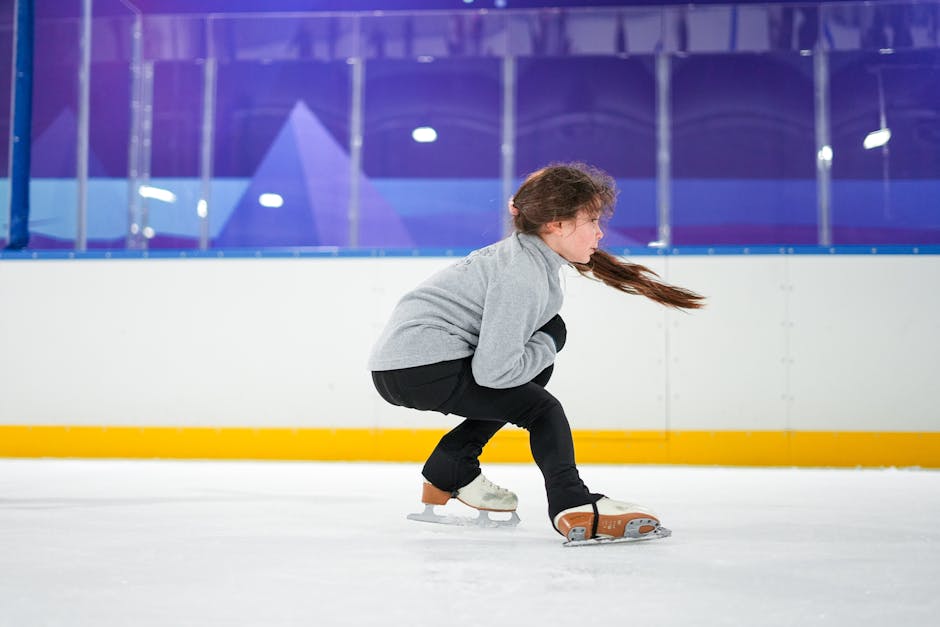
Watch a rookie try to execute a tight turn. What do they do? They lean their upper body while keeping their hips locked, sticking a leg out like an outrigger on a canoe. It hurts to watch. Their ankles collapse inward, scraping the ice instead of slicing it.
To build real edge mastery, you have to unlearn those bad habits. Your knees must track directly over your toes. Your shoulders need to stay level, even when your skates are tipped at a vicious forty-five-degree angle. It feels unnatural at first. You will feel like you’re falling. Trust me on this: the ice is there to catch you, provided your center of gravity is locked directly over the working blade.
My Go-To Edge Drills for Absolute Control
Enough theory. Let’s get to the ice. These are the exact drills I run whenever my skating feels sluggish or disconnected. Do these without pucks first. Master the body, then add the hardware.
1. The Pure Outside Edge C-Cuts
Forget everything you know about standard c-cuts. Line up along the goal line. Push exclusively with your outside edge, driving your heel out and away while keeping your upper body silent. Most skaters hate this drill because it exposes weak ankles immediately. Good. Lean into the burn. Do two full lengths down the ice, focusing entirely on a quiet upper body and an aggressive ankle press.
2. The Stationary Deep-Edge Pump
Stand parallel to the blue line. Drop into a deep squat—thighs parallel to the ice. Now, without taking your blades off the ice, shift your weight from your inside edge to your outside edge and back again. You should feel the ice groan under your boot as the steel bites. This builds the isometric leg strength required to hold an edge under heavy physical contact during a game.
3. Progressive Power Pulls
Start gliding on one foot. As you glide, use subtle hip rotation and ankle pressure to carve an ‘S’ shape into the ice without taking a single stride. Pull yourself through the arc using only edge pressure and upper body counter-rotation. If your speed dies halfway through the ‘S’, your edge angle was too shallow or your ankles collapsed. Reset and try again.
Translating Drill Work into Game Speed
Here is where most players fail the transition test. They look like world-class figure skaters during the pre-practice drills, then revert right back to flat-footed stomping the second the puck drops in a scrimmage. Edge work shouldn’t live in a vacuum.
When you are forechecking, you aren’t skating in straight lines. You are reacting, pivoting, and changing direction on a dime. By forcing yourself to execute every drill at eighty percent intensity, you build muscle memory. Eventually, your brain stops thinking about your ankles. Your feet just know where to go. That is when the game slows down. That is when you start dictating the pace.
Frequently Asked Questions
How long should I practice edge work during a typical week?
Dedicate the first 10 to 15 minutes of every single ice session exclusively to edge drills. Consistency beats marathon sessions every time. Ten minutes a day for a month yields infinitely better results than a single two-hour edge clinic.
Does skate sharpening affect my edge work?
Massively. If your hollow is too deep, you’ll get stuck in the ice during tight turns. If it’s too shallow, you’ll slide out. Most intermediate players thrive on a 1/2-inch or 5/8-inch hollow, but experiment to find what matches your weight and playing style.
Why do my ankles hurt when I try deep outside edge drills? That normal?
Initial soreness is normal because you are using stabilizer muscles that rarely get activated during straight-line skating. However, sharp, shooting pain means your skates don’t fit right or you are forcing your ankles to collapse rather than flexing your knees.
Can I practice edge work off the ice?
You can build ankle stability and balance using slide boards or balance pads, but nothing replaces actual steel on frozen water. The unique friction profile of ice cannot be perfectly replicated in running shoes.