The Ultimate Guide to Hockey Skate Blade Maintenance: Stop Ruining Your Steel
I’ve watched guys drop five hundred bucks on custom-profiled, DLC-coated steel runners only to toss them carelessly into the bottom of a damp hockey bag next to a half-rotten pair of socks. It makes me physically cringe. Here’s the ugly truth: your edges are the only things keeping you upright, yet most players treat them like an afterthought. If you want actual bite in your turns, lightning-fast transitions, and zero chatter when you stop on a dime, you need to understand how to care for your iron. Let’s cut through the noise and look at what it actually takes to maintain your hockey skate blades like a pro.

- • Anatomy of a Runner: Why Your Steel Deserves Better
- • The Post-Game Ritual That Separates Rec-League Hacks from Hardcore Players
- • Decoding Sharpening Frequency: When Is It Actually Time?
- ↳ The Danger of Over-Sharpening
- • Troubleshooting Common Blade Issues on the Bench
- ↳ Should I bake my skates if I get new steel installed?
- ↳ Can I fix a rusted skate blade myself?
- ↳ What is the best radius of hollow for beer league wingers?
- ↳ Why do my edges feel completely gone after playing on a newly resurfaced sheet?
Key Takeaways & Quick Overview
AI Verified
- ✔The ultimate guide to hockey skate blade maintenance: stop ruining your steel i’ve watched guys drop five hundred bucks on custom-profiled, dlc-coated steel runners only to toss them carelessly into the bottom of a damp hockey bag next to a half-rotten pair of socks.
- ✔Here’s the ugly truth: your edges are the only things keeping you upright, yet most players treat them like an afterthought.
- ✔If you want actual bite in your turns, lightning-fast transitions, and zero chatter when you stop on a dime, you need to understand how to care for your iron.
- ✔Let’s cut through the noise and look at what it actually takes to maintain your hockey skate blades like a pro.
Anatomy of a Runner: Why Your Steel Deserves Better
Most players think “steel is steel.” Big mistake. Modern runners are complex pieces of metallurgy. You’ve got stainless steel, carbon blends, and exotic titanium or carbon-nitride coatings designed to hold a bite longer. But beneath the marketing hype, physics rules the ice. Every time you dig into a tight turn, microscopic fractures occur along the edge. Leave those unchecked, and your glide degrades.
I’ve noticed a massive surge in players experimenting with different radius of hollows (ROH) without knowing the baseline mechanics of their steel. A standard 1/2-inch hollow gives you serious bite, but you trade away glide speed. Go shallower to 3/4-inch, and you fly down the wing—if your ankle strength can actually handle the reduced grip. Check out the USA Hockey equipment guidelines for more baseline technical specs on gear safety and maintenance standards.
The Post-Game Ritual That Separates Rec-League Hacks from Hardcore Players
You step off the ice. Your legs are toast. The last thing you want to do is spend three minutes on maintenance. Too bad. Do this or watch your expensive steel pit and rust.
First: ditch the plastic guards immediately. Those things are moisture traps. They hold condensation tight against your edge like a wet sponge sitting in a dark garage. I use a terrycloth towel to wipe every drop of water off the runner, the holder, and the rivets. Total time? Sixty seconds. Second, let your bag breathe. Zip it open the second you walk through your front door. If you leave wet steel cooking in an unventilated duffel bag overnight, oxidation starts eating away at the microscopic burrs on your edge. Once rust sets in deep, your sharpener has to grind away more steel than necessary just to hit fresh metal.
Decoding Sharpening Frequency: When Is It Actually Time?
How often should you sharpen? The old-school rule of thumb—”every five hours of ice time”—is a lazy generalization. It depends entirely on your weight, your playing style, and how often you accidentally step on the penalty box concrete with your naked blades (please, for the love of the game, always use walk guards when off the ice).
Run your fingernail gently down the side of the blade toward the edge. Does it catch smoothly, or does it feel slick and rounded? If you slide across the ice and feel like you’re skating on wet Teflon during a tight mohawk turn, your hollow is shot. For an elite-level view on international standards for gear durability, take a look at resources provided by the International Ice Hockey Federation. They see gear take a beating at world championships, and their equipment staff are ruthless about blade prep.
The Danger of Over-Sharpening
Here is a dirty secret local pro shops won’t always tell you: every time you grind a blade, you shorten its lifespan. A standard runner only has so much meat on it. If you hand your skates to an inexperienced kid running a grinding wheel at 100 miles per hour every single week when you don’t even need it, you’ll burn through a $150 set of steel in a single season. Learn to use a handheld stone or edge-checking tool to remove minor burrs between proper sharpenings.
Troubleshooting Common Blade Issues on the Bench
You take a hard spill into the boards, and suddenly your left outside edge feels dead. What happened? You likely took a nasty nick or rolled an edge.
- The Burr Check: Run a ceramic stone or debiting stick lightly down the flat side of the blade. Never run it directly across the bottom hollow—you’ll flatten your bite.
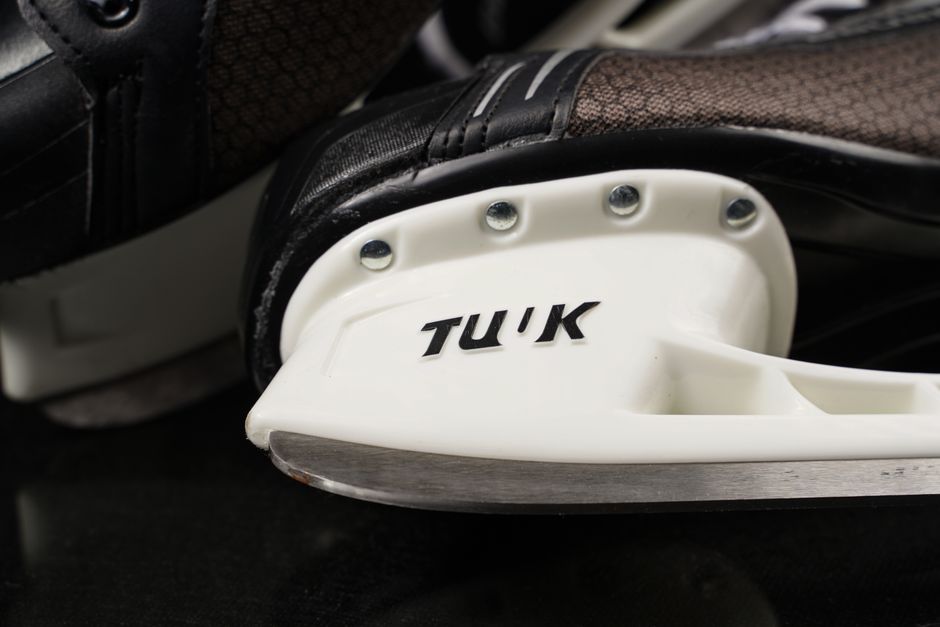
- Loose Holders: Sometimes it’s not the steel at all; it’s the rivets. If your runner shifts slightly inside the Tuuk or Bauer holder during a stride, you’ll lose power transfer instantly. Grab a screwdriver or take it to the shop to check rivet tightness.
- Uneven Grinds: If one side of your blade looks higher or lower, find a new sharpener. An uneven skate naturally pulls your ankles inward or outward, destroying your stride mechanics.
Frequently Asked Questions
Should I bake my skates if I get new steel installed?
No. Baking forms the boot composite around your foot shape. Steel installation is completely separate. However, if you switch to a taller runner profile (like going from standard steel to a +10mm profile), your stance and pitch will change drastically. Give yourself two or three practices to adjust to the new center of balance.
Can I fix a rusted skate blade myself?
Surface rust? Yes. Use a light oil or a fine-grit honing stone to gently buff it out before it pits the steel. If the rust has eaten deep orange craters into the actual hollow, stop messing around and take it to a professional sharpener who can grind past the corrosion.
What is the best radius of hollow for beer league wingers?
Most beer leaguers default to a 1/2-inch hollow because it’s what they had when they were twelve. If you are heavy on your feet or want more glide speed without sacrificing all your stopping power, try moving up to a 5/8-inch or 3/4-inch hollow. You’ll glide further per stride once you get used to the slightly looser feel.
Why do my edges feel completely gone after playing on a newly resurfaced sheet?
Fresh Zamboni water is often slightly warmer or wetter, creating a thin, frictionless layer that temporarily reduces edge bite for the first five minutes of a shift. If your edges *always* feel terrible after a fresh sharpen, your sharpener is likely burning the steel by running the wheel too dry or too fast.